
Dental treatments
All-on-4 dental implants
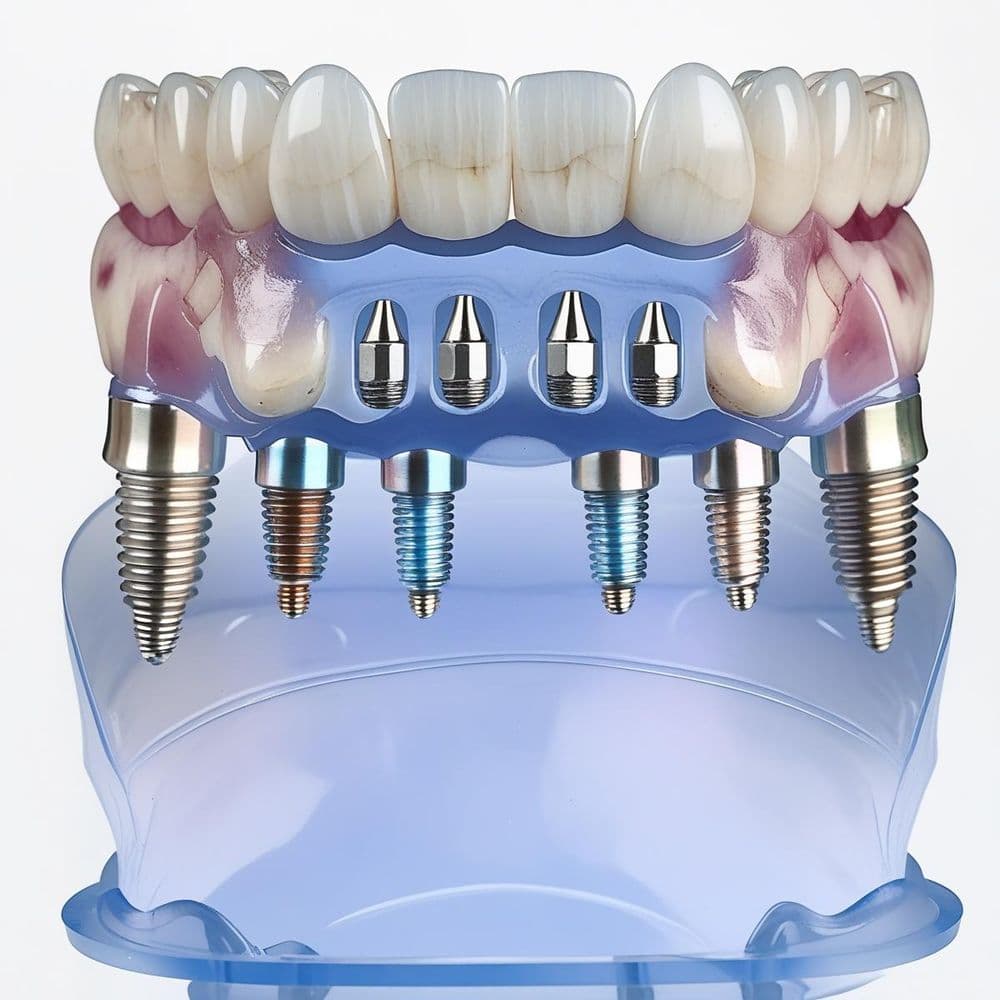
The All-on-4 treatment is intended for patients who have lost all the teeth of a jaw, or whose remaining teeth cannot be preserved.
- Duration
- Surgery often 2 to 4 hours; complete treatment over several months.
- Recovery
- Swelling, tenderness and difficulty chewing are possible for several days.
- Results
- Provisional prosthesis possible depending on the stability obtained; final prosthesis after healing.
Price and stay
All-on-4
from€4,800
- Stay
- 1st stay of 5 days, then a 2nd stay of 11 days about 3 months later
- Hotel
- Hotel not includedFor treatments over €10,000, one week of hotel accommodation is complimentary on the first stay.
Included
- 3D scan
- 4 implants
- Final prosthesis
Not included
- Bone graft
Price shown as a guide: your personalised quote, drawn up after assessment, is the one that applies.
Get a personalized quoteGoals and benefits
All-on-4: assessment, loading, maintenance and risks
The All-on-4 treatment is intended for patients who have lost all the teeth of a jaw, or whose remaining teeth cannot be preserved. Four implants are planned to support a complete fixed prosthesis, using the areas where bone is most available.
The benefits
- Complete fixed prosthesis supported by four planned implants
- Use of the most favourable bone areas of the jaw
- Prosthesis custom-designed for the treated jaw
- Force distribution designed according to the bone and the occlusion
- Can improve chewing and stability compared with a removable denture
- Aesthetics, phonetics and function adapted to the individual project
- Rapid provisional prosthesis possible only in selected cases
- Prosthetic maintenance and repairs possible when the system is followed up
Treatment video
Educational animation of the main treatment stages. The actual protocol is adapted to each patient's diagnosis.
Procedure
The treatment process
Clinical, bone and prosthetic assessment
Examination of the teeth and gums, cone beam scan, study of the bone volume, the sinuses, the nerves and the occlusion. Preservable teeth and possible infections are evaluated before the decision.
Planning of the implants and the prosthesis
The plan combines the implant positions, the shape of the prosthesis, lip support, the occlusion and the areas to keep accessible for cleaning.
Placement of the four planned implants
Four implants are placed according to the surgical and prosthetic plan, in the most favourable bone areas. Their actual position can be adapted during the operation if the anatomy requires it.
Provisional prosthesis when conditions allow
A fixed provisional prosthesis can be installed if sufficient stability is obtained and if the chewing constraints can be controlled. Otherwise, a transitional solution is preferred.
Healing, check-ups and final prosthesis
The implants and tissues are monitored during healing. After osseointegration, impressions and try-ins allow the final prosthesis to be made. Daily cleaning under the prosthesis remains essential.
Safety
Contraindications
- Infection, cavities or active periodontal disease to treat before surgery
- Insufficient bone volume or quality possibly requiring a graft or a different strategy
- Uncontrolled diabetes or unstabilised general disease
- Smoking, which increases the risk of failure.
Request your quote
Ready to transform your smile?
Send us your panoramic X-rays and photos to receive a free assessment and a detailed treatment plan within 24 hours.
Free consultation within 24h
Updated on